As parents, it’s amazing how much time and energy we spend either reflecting on or searching for solutions that would benefit the wellbeing of our children. Not to mention the time and energy dedicated to caring for them, day by day, every day. It’s normal, as we are responsible for them. And at times, it can be so overwhelming.
‘Always’ on our mind
Our children are often on our mind. We want them to be happy, healthy and feel loved. We want them to grow and be fulfilled. We want them to explore the world and develop. We want them to be protected and safe. We want them to have as many opportunities possible, perhaps even the opportunities we did not have when we were children. We care so much about our children, that most of the times, words do not have the capacity to describe.
We often reflect on how our children can have enough sleep, we identify ways to optimise their sleep routine, we look at ways to provide them a balanced diet. We explore ways to (co)regulate their emotions and help them deal with their everyday stress. We search for environments that would enable them to learn and grow. We register them and taking them to various activities, in order to allow them to develop.
And we do so much more, as each family, children and parents have their own struggles and challenges. In any case, as a parent, it seems normal to have the needs of our children pretty much ‘always’ on our mind, and especially for mothers, who usually have a higher mental load related to children, family life and household management, on top of everything else.
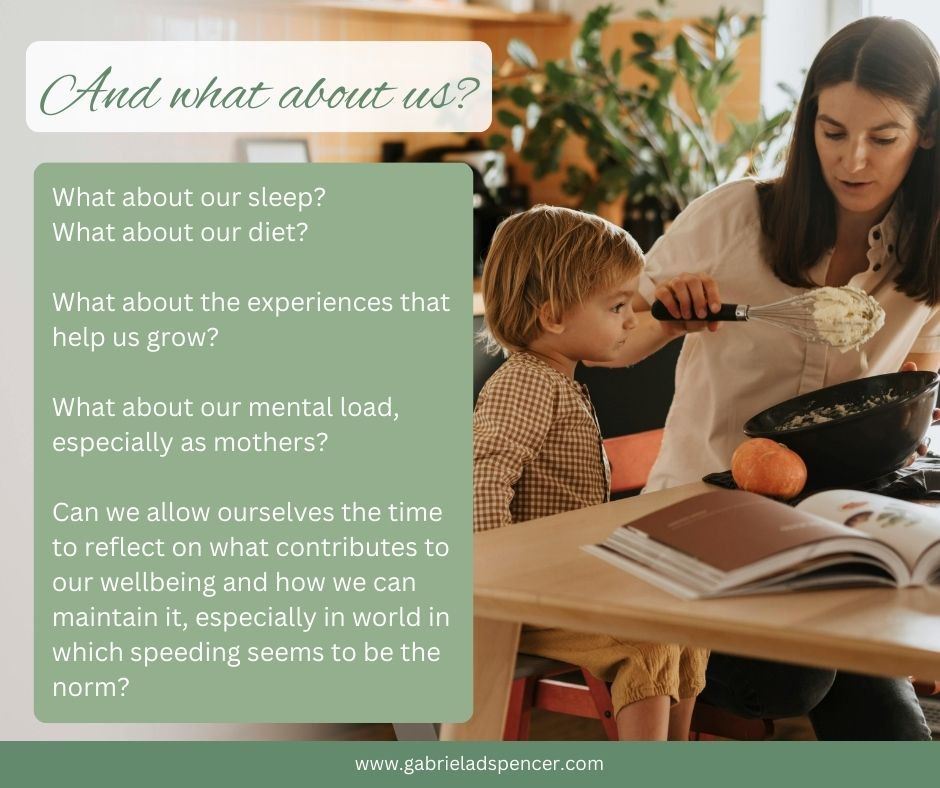
But what about us, the parents?
But what about our sleep routine, sleep quality and the actual time spent sleeping?
What about balancing our diet and keeping healthy eating habits? What about regulating our own emotions, as opossed to rejecting and denying them as a way to « manage » them? Fun fact, most of us may still have difficulties identifying, expressing and regulating our own emotions.
What about appeasing our own stress that we face every day?
What about our own development and the activities that our heart and inner child desires?
And what about our mental load? What about finding more sustainable ways to deal with our never-ending sources of stress?
Can we also give ourselves the permission to reflect on what contributes to our wellbeing and on the ways we can maintain it, especially in world in which speeding seems to be the norm?
Reflecting clearly on our own is not always realistic. We can easily get distracted by the next urgent thing to attend, or we can get stuck in our own thinking.
Reflecting in two, through the partnership of one-on-one coaching allows us to show up as we are, and reflect in the safe space of the coaching coversation, whilst being welcomed with empathy and compassion. Prompted by open questions, we can find ways to get more clarity, make more reflected decisions and ultimately support ourselves and our wellbeing, both in the short and long-term.
How having access to the coaching space helped me, as a future and new mother?
I was coached a lot before, during and after becoming a mother. As a matter of fact, the framework of coaching allowed me to verbalise and process the obstacles that I had related to becoming a mother. Guess what, some of the obstacles were indeed related to my situation, circumstances and environment, and some others were related to what I had internalised related to the motherhood and childhood during my upbringing. Some obstacles, that required deep emotional processing and emotional healing, were also supported by therapy, as therapy and coaching can complement eachother.
Through coaching I explored what was keeping me stuck into indecision and lack of action related to motherhood. I also explored the possible difficulties that I would encounter as a new mother, which appeased my level of anxiety related to this life change. The coaching conversations also allowed me to clarify what kind of mother I wanted to be, what kind of sacrifices I was willing to do in the short and long term, and what kind of partnership in raising a child I would have liked to have with my husband. I explored also my inner and external resources and giving myself the permission to ask for help.
Before I became a parent, I read in a book for new parents to expect a roller-coaster of emotions. And that was my reality for a very long time (at least in the first 20 months), as many new parents can confess.
Having access to the framwework of coaching provided me with the emotional support I needed, especially when things were really difficult, due to the exhaustion and sleep deprivation that were affecting me physically, cognitively, emotionally and mentally. Words cannot describe the level of exhaustion I had due to the constant sleep deprivation, sometimes more acute (up to 6 hours of wakefulness a night, during the first 18 months) and sometimes simply chronic, as my child starting to sleep ‘better’ through the night around 2years and a half. (I say sleep ‘better’, as there is still a lot of room for improvement)
I was also adviced to befriend with chaos and imperfection, and I must say that chaos pretty much defined the first two years of motherhood, despite of the adaptation going on, despite the support I received from my own mother and the huge dedication and implication from my husband, and despite the continous learning and the time that had passed by.
Having a partner in my coach to explore, process and takcle how the chaos and imperfection were affecting my life and my personal and professional identities, was an immense support. As a matter of fact, I am thanking (again) my coach for all her patience, support and availability, late in the evening, and especially during those particlar sessions when I was in tears, trying to reflect with a foggy sleep deprived mind, whilst holding or rocking a baby /toddler in my arms.
Interested in one-on-one Coaching?
If you are interested in being supported through one-on-one coaching to transition to motherhood/parenthood, if you would like to explore ways to integrate wellbeing into your personal or professional life, if you are concerned about burn-out prevention (whether occupational burn-out or parental burn-out), or you would like to partner to reflect on anything else impacting your overall wellbeing, reach out for a FREE Discovery Call for Coaching.
Coaching is a process that blends introspection and taking personal responsibility. It is a partnership that respects our pace and it reconnects us with our resources and values. It provides support and enables our autonomy. It helps us move forward, in our terms.
As a coach professional, I blend mental and body orientated coaching techniques, curiosity, spontaneity, humbleness and intuition. Ethics and standards in coaching are very important to me. I am a member of the International Coaching Federation and I am committed to ongoing coach learning.
Learn more about the Free Discovery Call for Coaching
Discover more from Gabriela D. Spencer
Subscribe to get the latest posts sent to your email.

 Gabriela D. Spencer